Already a customer?
Sign in to shop!
 First
time customer?
First
time customer?

|
|
 |
Track
Your Order
 |
Sign
up for our FREE e-mail newsletter!
|

|
This sight is best viewed usingMicrosoft Internet Explorer
5.0 or Newer. Click on the link to Download the latest
version.

|
|
|
|
|
 |
| |
| Glossary |
| A-C
: D-L :
M-P : S-Z
|
| M
|
Multilayer
bottles
Containers
composed of layers of specially selected plasxtics which
are coextruded so that the unique characteristics of each
material are retained. The objective is to improve the
barrier qualities of the container, resulting in a longer
shelf life.
|
| N |
Narrow
mouth
The
finish of a container that is small in proportion to the
diameter of the body.
Natural color
Describes
the translucent appearance of a plastic material which
has not been colored.
Neck
The
part of a container where the bottle cross-section slenderizes
to form the finish.
|
| O |
Orifice
An
opening in a dispensing closure or fitment from which
the product is despensed.
Overcap
A
cap (usually plastic) provided with some cans. It is used
to cover the open end once the can has been opened. Sometimes,
it is used to describe a cap which is used to cover the
primary closure or other dispensing system, such as a
fingertip sprayer or aerosol valve.
|
| P |
Phenolic
The
generic name for phenolformaldehyde thermosetting plastic
that's molded or cast.
Polyethylene,
high-density (HDPE)
In
the high-density grade, this thermoplastic material is
more rigid and less permeable than the low-density grade.
It also displays a higher tolerance to distortion temperatures.
HDPE is the most widely used resin for extrusion blown
plastic bottles. This material is economical, impact resistant,
and provides a good moisture barrier. HDPE is compatible
with a wide range of products including acids and caustics
but is not compatible with solvents. It is usually supplied
in FDA approved food grade.
HDPE is naturally translucent and flexible. The addition
of color will make HDPE opaque although not glossy. Adding
extra weight to the bottle will yield a rigid container.
HDPE is supplied flame-treated on a stock basis and lends
itself readily to silk screen decoration. While HDPE provides
good protection at below freezing temperatures, it cannot
be used with products filled at over 160° F or products
requiring a hermatic seal.
Polyethylene,
low-density (LDPE)
Squeezability
is good, especailly in the low-density grade of this thermoplastic
material. It also displays better resistance to impact
than the high-density grade.
LDPE is similar to HDPE in composition. It is less rigid
and generally less chemically resistant than HDPE, but
is more translucent. LDPE is used primarily for squeeze
applications. LDPE is significantly more expensive than
HDPE, but will yield a glossy bottle when produced in
colors.
Polyethylene,
medium-density (MDPE)
MDPE
combines the characteristics of low and high density polyethylene.
Bottles are less translucent than LDPE but more flexible
than HDPE. Like LDPE, MDPE is glossy when produced in
colors.
Polyethylene
terephthalate (PET)
A
resin with outstanding clarity and good resistance to
impact, along with good barrier properties to resist grease
and oil, cold and sunlight.
Polyethylene Terephthalate is an excellent material for
use in orientation blow molding (stretch blow molding).
It is commonly used for carbonated beverage bottles. Oriented
PET provides very good alcohol and essential oil barrier
properties, generally good chemical resistance (although
acetones and ketones will attack PET) and a high degree
of impact resistance and tensile strength. The orienting
process also serves to improve gas and moisture barrier
properties.
This material does not provide resistance to high temperature
application (max. temp. 160° F). However, heat-set
PET creates a container which will accept a 195° F
hot fill and exhibit the clarity of other PET containers.
This process provides an alternative to glass for products
such as juice.
Polyethylene
terephthalate glycol (PETG)
A
resin with good barrier properties and outstanding clarity,
with a slightly higher tolerance to distortion temperatures,
as compared to PET.
PETG: Glycol modified Polyethylene Terephthalate is a
durable material with excellent gloss, clarity and sparkle
desired for clear bottles. PETG can be processed via conventional
extrusion blow molding methods, generally on machines
designed to process PVC.
Applications include shampoos, soaps, and detergents.
PETG exhibits a good impact strength and gas barrier.
The chemical resistance of PETG is fair and compatibility
testing is recommended, especially with products that
contain alcohol.
Polypropylene
(PP)
A
tough, lightweight, rigid plastic made by the polymerization
of high-purity propylene gas in the presence of an organometallic
catalyst at relatively low pressures and temperatures.
Polypropylene is a naturally translucent material which
provides contact clarity and an excellent moisture barrier.
PP is easily processed via injection molding (jars and
closures), and injection, extrusion, or stretch blow-molding
(bottles). One major advantage of polypropylene is its
stability at hight temperatures, up to 200° F. Polypropylene
is autoclavable and offers the potential for steam sterilization.
The compatibility of PP with high filling temperatures
is responsible for its use with hot fill products such
as pancake syrup.
PP has excellent chemical resistance, but provides poor
impact resistance in cold temperatures. Oriented PP offeres
improved impact resistance and clarity at low temperatures.
Produced in color, PP exhibits a glossy finish.
Polystyrene
(PS)
Thermoplastic
compound used to make plastic containers, closures and
more.
Polyvinyl
chloride (PVC)
A
thermoplastic material composed of polymers of vinyl chloride;
a colorless solid with outstanding resistance to water,
alcohols, concentrated acids and alkalis.
PVC is naturally clear, has extremely good resistance
to oils, and has very low oxygen transmission. It provides
an excellent barrier to most gasses and its drop impact
resistance is also very good. This material is also very
chemically resistant, but it is vulnerable to solvents.
PVC is a semi-rigid material which, when produced on extrusion
blow-molding equipment, can accommodate handled designs.
PVC is available in different grades depending on its
application. These grades include general purpose grade,
food grade, and fragrance-guard perume grade. The occurrence
of the blue tint in clear PVC can be modified by controlling
the toner levels in each of these grades. PVC is also
available in a rigid injection blow molding grade.
General Purpose PVC exhibits poor resistance to high temperatures
and will distort at 160° F, making it incompatible
with hot filled products. New PVC grades are able to withstand
temperatures up to 190° F and can be hot filled. Since
it provides a good oxygen barrier, PVC is an excellent
choice for salad oil, mineral oil, and vinegar. It is
also commonly used for shampoos and cosmetic products.
Polyvinylidene
chloride (PVDC)
Improves
barrier properties to increase shelf life or to protect
product. Used as a barrier material in a coating form,
a layer in lamination or as part of a coextruded structure
for a rigid container. |
|
|
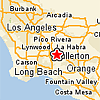 |
Location
13918 Equitable Rd.
Cerritos, CA 90703-2315
Main: (562) 802-0515
Fax: (562) 802-0501
Click here for a map
 |
Note: Prices and product availability are subject to change
without notice. |
|
|